This morning we went to Ho-Chi-Minh complex. This is where Ho-Chi-Minh himself lays in state. We walked around the complex looking at his living quarters, cars, and gardens. One highlight of this visit was all of the school kids visiting the same place. They like to say hello!
Next we headed off to the local market! This market was quite fun, they had meat, veggies, and fruit! After the visit at the market we had a wonderful lunch at Nguviquan 5 Spice Restraunt, this was very good!
As we type today's blog we are sitting at the airport waiting our flight to Ho-Chi-Minh City (commonly known as Saigon)!
Sarah Jorgensen, Kari Vanderwal, Jim Kopriva
Thursday, February 16, 2012


Thursday, 2/16 photos, Vietnam

Local transportation

Group

Group at Ho Chi Minh mausoleum

School children

With guide Ta Dang Thai (right)

Market at Hanoi

Market

Market

Lunch
(Posted by Cheryl for Dan and Michelle)
Wednesday, February 15, 2012
February 14 photos

At Vietnam Farmer's Union

Enroute to farmer's field

Rice field

Rice greenhouses

Guide and farmer with spouse

Group at farm

Water buffalo

Worker enroute to rice field

Planting rice

Swine production

At village

Traffic in Hanoi
(Posted by Cheryl for Dan and Michelle)
Monday/Tuesday, February 13/14--Vietnam
Tuesday morning we departed from Guangzhou for Hong Kong by bus where we split our group and 22 of us continued on to Hanoi, Vietnam. The rest spent their final day in Hong Kong before departing for home Wednesday morning. The group in Vietnam were treated to a traditional Vietnamese supper at the Banana Flower restaurant.
Wednesday morning we met with Vietnam Farmer’s Union (VFU) where five officials were able to join us and share information about Vietnam agriculture as well as answer some questions. VFU is headquartered in Hanoi and has a 10 million members in 63 provinces. Of the 87 million people in Vietnam, 60% are farmers. They raise predominately rice (seven different varieties), crops and vegetables, and seafood. Vietnam exports rice, coffee, pepper, and seafood (catfish) and imports fruit and milk products. They are very passionate about promoting agriculture and teaching safety and ag production within their country. They have an advancement program for women to promote gender equality and development as 40% of their membership is women. We extended an invitation to them to visit South Dakota and showcase our ag industry as well as share the SDARL program curriculum. After a delicious Vietnamese lunch, we had the opportunity visit our tour guides home village. The farmer we visited rents 10 hectares from the government and raises ducks, pigs, and fish. We also got to see water buffalo tethered on the road, rice nurseries, and rice being planted in the paddies. The villagers were very welcoming and shared some of their businesses- rice saki distillery where they make saki and use the byproduct to feed the pigs, families that made products to burn during festivals in honor of their ancestors, and bamboo weavers making life size animal decorations for their festivals. After a quick shopping stop, we headed back to the hotel and had a free evening.
Respectfully submitted,
Marlin Nilsson and Danci Baker
Wednesday morning we met with Vietnam Farmer’s Union (VFU) where five officials were able to join us and share information about Vietnam agriculture as well as answer some questions. VFU is headquartered in Hanoi and has a 10 million members in 63 provinces. Of the 87 million people in Vietnam, 60% are farmers. They raise predominately rice (seven different varieties), crops and vegetables, and seafood. Vietnam exports rice, coffee, pepper, and seafood (catfish) and imports fruit and milk products. They are very passionate about promoting agriculture and teaching safety and ag production within their country. They have an advancement program for women to promote gender equality and development as 40% of their membership is women. We extended an invitation to them to visit South Dakota and showcase our ag industry as well as share the SDARL program curriculum. After a delicious Vietnamese lunch, we had the opportunity visit our tour guides home village. The farmer we visited rents 10 hectares from the government and raises ducks, pigs, and fish. We also got to see water buffalo tethered on the road, rice nurseries, and rice being planted in the paddies. The villagers were very welcoming and shared some of their businesses- rice saki distillery where they make saki and use the byproduct to feed the pigs, families that made products to burn during festivals in honor of their ancestors, and bamboo weavers making life size animal decorations for their festivals. After a quick shopping stop, we headed back to the hotel and had a free evening.
Respectfully submitted,
Marlin Nilsson and Danci Baker
Tuesday, February 14, 2012
Photos, Monday, February 13

At the vegetable market

Load of corn at the vegetable market

Rosedale Hotel

At a Buddhist temple

At the temple

Jorge Sanchez from Agriculture Trade Organization

Jorge and class members

At the grocery store

On Pearl River cruise

Denny, Jan, Michelle, Rae, Dan
(Posted by Cheryl for Dan and Michelle)
Monday, February 13
General Seminar Managers – Glen Crawford and Joey Hanson, Reporter – Lealand Schoon
An optional tour of the fresh seafood, fruit and vegetable markets was made available. Twenty-four people of SDARL Class 6 loaded the motor coach at 5:00 am. The morning was still, humid and dark. Unlike the night life, the neon lights were off, the traffic would barely be considered as calm; not a bicycle or person was moving.
Seafood markets in Guangzhou are not side by side, but rather distributed throughout the city. The Huangsha Aquatic Products Seafood Market is a 24-hour market providing farm grown fresh (alive) sea critters. Being a wholesale market, buyers would come from restaurants, hotels, groceries throughout China to purchase here. Most every shop was open to the street, well-lit and no terrible fishy odor. Critters observed were frogs, eels, a variety of fish from minnow size to 2-3 foot catfish or carp, lobsters, snails, abalone, live alligators, ducks and snakes. No critters were raised from the wild. An interesting consideration was that anything which was in a crate or caged, we were politely waved off as not to photograph. Considering these are farmers, perhaps they were concerned with photographs falling into the wrong hands for animal rights groups; similar to concerns in the US.
Fruits and veggies- Our next trip was to the fruit and vegetable market in a different part of the city. The traffic began to pick up with more automobiles, bicycles and motorcycles. As we entered the Jiangnan fruit and vegetable market with the bus, we were easily amused. The employee at the booth-gate asked the driver “ if the bus was loaded with meat or people.” The market was in a large four-level outdoor car parking garage. To the right were various fruits actively being marketed and sold. To the left, vegetable products were being unloaded and organized. The fruit was very well displayed, similar to how you’d see it a Mr. Hoopers store front on Sesame Street. A walk through the vegetable side was humbling as it could be appreciated that these were products grown and harvested by rural farmers. Most vegetables must be handled 7-12 times. No forklifts were used; instead a chain of people with the first- high on a 20 foot tall loaded triple axle-duel semi-trailer to the person rolling the four wheeled cart on the ground. This market was observed to be cleaner then that mentioned in Beijing. No trucks or packaging had much for major “branding” boxes and some packaging was printed in Chinese, together with English. Products observed were corn-on-the-cob in husks, eggplant, tomatoes, onions, carrots, squash, turnips, lettuce, celery. Also dragon fruit, oranges, star fruit, bamalo, grapes, apples, plums and strawberries.
By 7:30 am China’s third largest city was on the move with automobiles, small trucks, buses, bicycles, mopeds and pedestrians going and coming. For the first time in three days we could see the sun peaking through spaces between the clouds.
Temple- Officially, our day started by departing on the motor coach at 10:30 am. The sunshine was welcome as the clouds finally cleared off. However, especially from the 19th floor of the hotel, one can truly see that it is smog in the air; a whitish-brown fog which engulfs the city buildings, like fog which hangs in a South Dakota river valley on a spring morning; the difference being that smog doesn’t move away and if there is an odor, it has been masked by the busyness of the city.
Along the way, our tour guide Jocelyn provided the following answers to our questions:
-All buses run on LPG-propane fuel and a few on electric cables. No motor powered motorcycles are allowed, most run on battery power.
-A number of Chinese people wear glasses, however,contact lens are also very common. Public health care makes both eye and dental care more reasonably priced, however there are private practitioners as well. The government does the licensing.
-The deceased in the city must be cremated. Those in the country can still have full body burials. There are three main places in Guangzhou which boxes with the cremated can be placed.
-Chinese keyboards have the 26 letter alphabet, yet when it is printed or texted, the series of letters will spell the words or sentences of their intention in Chinese script.
-Clothes dryers are available, but not common. Therefore laundry can be observed hanging outside windows where they are allowed to dry.
We made our way through the leafed, tree-lined streets towards the Buddhist Temple. Care was taken when stepping out of the bus onto the street so not to be hit by passing cars or bicycles. These drivers are very aware of pedestrians and it is very interesting that there aren’t more collisions. The following will give an idea of how Buddhism was described to us.
Like many communities there is more than one place of worship throughout the city. This one had historical significance and was busy with Buddhist people offering incense. As soon as we stepped through the gate, one could smell and see the sweet-smoke aroma of the incense.
There really is no set religious day. The temples are not open 24 hours. Most do have Monks both male and female living nearby with crew-cut style haircuts and traditional Buddhist clothing. There are ceremonies on certain days where people will come to perform their worship.
Statues are very colorful. The four statues when entering the temple courtyard are there to protect the four directions and resources to provide for a good agrarian production and harvest. One could not miss the nine- story Pagoda which is a place to store relics. It’s white block walls stood in contrast to the dark brown wood trim and railing. This Pagoda has stood for 1400 years being rebuilt four times; it’s original damage was from an earthquake. It was built without the use of nails.
The donation park is an area at the entrance with a 12-14 ft steel structure which almost resembles a pot-belly stove. People drop incense here as a donation. The incense sticks look like 12-16 inch long punks like what would be used to light fireworks, yet are much more pungent and are offered in 3’s,6’s or 9’s. There are six different areas to offer incense.
The next building is the Main Temple which has three 20 foot tall bronze statues within. An Indian Prince started Buddhism and these three statues resemble him. Buddhism therefore has its origin in India, however, it was adopted together with Taoism as the official religion of China and has been for over 2000 years. These statues have been rebuilt in 1955 as the originals were destroyed during the “Cultural Revolution”.
The areas within the courtyard is a Buddha Tree (theory of people’s suffering), Building to Offer Confession, Building of a Master (six stages of life that human’s step through) and a Building of Memory (memorial to those who have passed). Traditionally to be Buddhist, one must leave everything and enter the temple life as a Monk. More recently however, a person may be allowed to be a Buddhist so long as they live it in their heart.
Ag Trade Office- SDARL Class 6’s visit to the American Consulate-Guangzhou Commercial Section or Ag Trade Office and meeting with Ag Consul, Jorge Sanchez. Mr. Sanchez’s office produces crop reports to help keep markets from fluctuating out of control. There is a cohesive network of partners and communication to China’s farmers which provides for their reports to be 80% correct. He entertained questions after his overview.
-China’s 3 major staples are 1) vegetable oil (need for quality and protein), 2) rice and 3) pork.
-China’s people are very much involved on social-issues through communication, such as Micro-blogs.
-The largest exports to China are 1) soybean, 2) cotton, 3) wood products and 4) hides and skins. These are all materials. USA needs to position oneself to export Consumer Ready Goods, which Americans are employed to make.
-China’s culture see’s trade issues different than that of the USA Culture. Where the USA would see trade of Ag issues, for Ag issues – China might see trade for rubber products in order to influence Ag products.
-There is a need to build Advocacy Groups over the next 30 years. Need to improve relations and reach in with feed millers and companies which will better nourish China’s consumers.
-Mr. Sanchez describes that China’s people trust USA and its products as USA has more consistent laws and regulations than other countries they trade with.
-China has things under control. As an example of corn. China is not reliant on USA Corn as has imports of feed wheat and other feed grains with other countries.
Pearl River Cruise – The final experience in Guangzhou was to cruise the Pearl River. It was dark by the time we boarded the Swedish replica wooden ship, dating back some 400 years. It’s masts were folded down and it was diesel motored. It was a very pleasant evening with a smooth ride. We had our supper on this ship and squid was the unique feature. The trip was for two hours where we enjoyed fellowship, sights of apartment buildings and high-rises which would change neon colors. We passed under 8 of the 10 bridges for which the Pearl River and Guangzhou are known and they also change neon in color.
Overall the day was filled with new and interesting experiences.
An optional tour of the fresh seafood, fruit and vegetable markets was made available. Twenty-four people of SDARL Class 6 loaded the motor coach at 5:00 am. The morning was still, humid and dark. Unlike the night life, the neon lights were off, the traffic would barely be considered as calm; not a bicycle or person was moving.
Seafood markets in Guangzhou are not side by side, but rather distributed throughout the city. The Huangsha Aquatic Products Seafood Market is a 24-hour market providing farm grown fresh (alive) sea critters. Being a wholesale market, buyers would come from restaurants, hotels, groceries throughout China to purchase here. Most every shop was open to the street, well-lit and no terrible fishy odor. Critters observed were frogs, eels, a variety of fish from minnow size to 2-3 foot catfish or carp, lobsters, snails, abalone, live alligators, ducks and snakes. No critters were raised from the wild. An interesting consideration was that anything which was in a crate or caged, we were politely waved off as not to photograph. Considering these are farmers, perhaps they were concerned with photographs falling into the wrong hands for animal rights groups; similar to concerns in the US.
Fruits and veggies- Our next trip was to the fruit and vegetable market in a different part of the city. The traffic began to pick up with more automobiles, bicycles and motorcycles. As we entered the Jiangnan fruit and vegetable market with the bus, we were easily amused. The employee at the booth-gate asked the driver “ if the bus was loaded with meat or people.” The market was in a large four-level outdoor car parking garage. To the right were various fruits actively being marketed and sold. To the left, vegetable products were being unloaded and organized. The fruit was very well displayed, similar to how you’d see it a Mr. Hoopers store front on Sesame Street. A walk through the vegetable side was humbling as it could be appreciated that these were products grown and harvested by rural farmers. Most vegetables must be handled 7-12 times. No forklifts were used; instead a chain of people with the first- high on a 20 foot tall loaded triple axle-duel semi-trailer to the person rolling the four wheeled cart on the ground. This market was observed to be cleaner then that mentioned in Beijing. No trucks or packaging had much for major “branding” boxes and some packaging was printed in Chinese, together with English. Products observed were corn-on-the-cob in husks, eggplant, tomatoes, onions, carrots, squash, turnips, lettuce, celery. Also dragon fruit, oranges, star fruit, bamalo, grapes, apples, plums and strawberries.
By 7:30 am China’s third largest city was on the move with automobiles, small trucks, buses, bicycles, mopeds and pedestrians going and coming. For the first time in three days we could see the sun peaking through spaces between the clouds.
Temple- Officially, our day started by departing on the motor coach at 10:30 am. The sunshine was welcome as the clouds finally cleared off. However, especially from the 19th floor of the hotel, one can truly see that it is smog in the air; a whitish-brown fog which engulfs the city buildings, like fog which hangs in a South Dakota river valley on a spring morning; the difference being that smog doesn’t move away and if there is an odor, it has been masked by the busyness of the city.
Along the way, our tour guide Jocelyn provided the following answers to our questions:
-All buses run on LPG-propane fuel and a few on electric cables. No motor powered motorcycles are allowed, most run on battery power.
-A number of Chinese people wear glasses, however,contact lens are also very common. Public health care makes both eye and dental care more reasonably priced, however there are private practitioners as well. The government does the licensing.
-The deceased in the city must be cremated. Those in the country can still have full body burials. There are three main places in Guangzhou which boxes with the cremated can be placed.
-Chinese keyboards have the 26 letter alphabet, yet when it is printed or texted, the series of letters will spell the words or sentences of their intention in Chinese script.
-Clothes dryers are available, but not common. Therefore laundry can be observed hanging outside windows where they are allowed to dry.
We made our way through the leafed, tree-lined streets towards the Buddhist Temple. Care was taken when stepping out of the bus onto the street so not to be hit by passing cars or bicycles. These drivers are very aware of pedestrians and it is very interesting that there aren’t more collisions. The following will give an idea of how Buddhism was described to us.
Like many communities there is more than one place of worship throughout the city. This one had historical significance and was busy with Buddhist people offering incense. As soon as we stepped through the gate, one could smell and see the sweet-smoke aroma of the incense.
There really is no set religious day. The temples are not open 24 hours. Most do have Monks both male and female living nearby with crew-cut style haircuts and traditional Buddhist clothing. There are ceremonies on certain days where people will come to perform their worship.
Statues are very colorful. The four statues when entering the temple courtyard are there to protect the four directions and resources to provide for a good agrarian production and harvest. One could not miss the nine- story Pagoda which is a place to store relics. It’s white block walls stood in contrast to the dark brown wood trim and railing. This Pagoda has stood for 1400 years being rebuilt four times; it’s original damage was from an earthquake. It was built without the use of nails.
The donation park is an area at the entrance with a 12-14 ft steel structure which almost resembles a pot-belly stove. People drop incense here as a donation. The incense sticks look like 12-16 inch long punks like what would be used to light fireworks, yet are much more pungent and are offered in 3’s,6’s or 9’s. There are six different areas to offer incense.
The next building is the Main Temple which has three 20 foot tall bronze statues within. An Indian Prince started Buddhism and these three statues resemble him. Buddhism therefore has its origin in India, however, it was adopted together with Taoism as the official religion of China and has been for over 2000 years. These statues have been rebuilt in 1955 as the originals were destroyed during the “Cultural Revolution”.
The areas within the courtyard is a Buddha Tree (theory of people’s suffering), Building to Offer Confession, Building of a Master (six stages of life that human’s step through) and a Building of Memory (memorial to those who have passed). Traditionally to be Buddhist, one must leave everything and enter the temple life as a Monk. More recently however, a person may be allowed to be a Buddhist so long as they live it in their heart.
Ag Trade Office- SDARL Class 6’s visit to the American Consulate-Guangzhou Commercial Section or Ag Trade Office and meeting with Ag Consul, Jorge Sanchez. Mr. Sanchez’s office produces crop reports to help keep markets from fluctuating out of control. There is a cohesive network of partners and communication to China’s farmers which provides for their reports to be 80% correct. He entertained questions after his overview.
-China’s 3 major staples are 1) vegetable oil (need for quality and protein), 2) rice and 3) pork.
-China’s people are very much involved on social-issues through communication, such as Micro-blogs.
-The largest exports to China are 1) soybean, 2) cotton, 3) wood products and 4) hides and skins. These are all materials. USA needs to position oneself to export Consumer Ready Goods, which Americans are employed to make.
-China’s culture see’s trade issues different than that of the USA Culture. Where the USA would see trade of Ag issues, for Ag issues – China might see trade for rubber products in order to influence Ag products.
-There is a need to build Advocacy Groups over the next 30 years. Need to improve relations and reach in with feed millers and companies which will better nourish China’s consumers.
-Mr. Sanchez describes that China’s people trust USA and its products as USA has more consistent laws and regulations than other countries they trade with.
-China has things under control. As an example of corn. China is not reliant on USA Corn as has imports of feed wheat and other feed grains with other countries.
Pearl River Cruise – The final experience in Guangzhou was to cruise the Pearl River. It was dark by the time we boarded the Swedish replica wooden ship, dating back some 400 years. It’s masts were folded down and it was diesel motored. It was a very pleasant evening with a smooth ride. We had our supper on this ship and squid was the unique feature. The trip was for two hours where we enjoyed fellowship, sights of apartment buildings and high-rises which would change neon colors. We passed under 8 of the 10 bridges for which the Pearl River and Guangzhou are known and they also change neon in color.
Overall the day was filled with new and interesting experiences.
Monday, February 13, 2012
Photos, Sunday, February 12

Meeting at Dongling soybean crushing facility

Tour at Dongling

Loading soybean oil meal

Group at Dongling
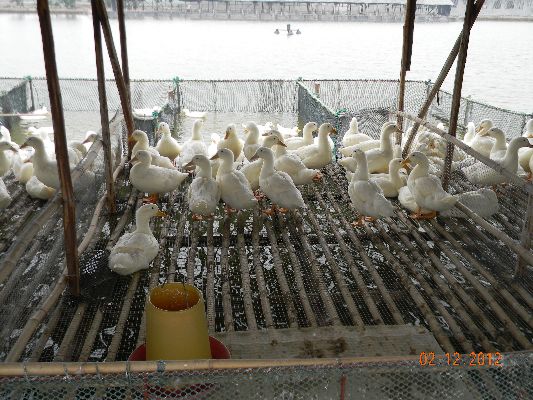
Duck production over fish ponds

Fish ponds at Haid group

Nearly loaded

Welcome at Haid group

Group at Haid group
(Posted by Cheryl for Dan and Michelle)
Subscribe to:
Posts (Atom)