Thursday, February 20, 2020

Day 5 of SDARL CLASS X LEADERSHIP TRIP to VIETNAM AND CAMBODIA

We started Day 5 with a boat ride up the Mekong river to visit local craftsman and the river’s famous floating market of Cai Rang.  The river is busy everyday and we witnessed that as we met or passed tour boats; boats delivering or preparing to sell their goods at the floating market; barges both large and small hauling everything from sand to rock to container cargo; fishing boats and others just moving on the river.  Several of the boat operators live in houses along the river.  Some houses had mangrove poles stacked against them or on the river banks.  
These poles are used for foundations of houses. The poles can last 50 years.  


Some of the river vendors live on the river but others have outside jobs and market their products from the boat on a part time basis.  


Tidal flows impact the river and in the morning the tide is coming back in.  Jessica, our tour guide, explained that high tide would occur around 4:00 pm. One noticeable threat to the river is the large amount of garbage both on the shore and in the water.  Jessica explained that the garbage constitutes an overall challenge to the health of the river and ultimately poses a threat to the ocean environment.

On our first stop we visited a rice noodle market. We were able to watch and participate in the making of rice noodles:


The rice is ladled onto a hot cooking surface.

 The rice is steamed for a few seconds.

 Jennifer lifts the rice mixture with a wicker roller.

Jennifer rolls out the rice to dry.

Laying dried rice paper on the shredder.

Rice is cut into noodles.

Once the noodles are made the marketplace packages rice noodles for sale plus makes a pizza that is unique to this market.  The pizza is not at all like American pizza with its main ingredients of rice noodles and tomato paste, but was still very tasty!

Continuing up the river we visited the Cho Noi or floating market.  


The Cai Rang people from the countryside load their boats and come down the river to the market. They will live on the boat for 3 to 4 days while they sell their produce. Once they sell the produce, they go back home to refill their boats. For the market, people go from boat to boat to purchase the different products. Once we stopped at the first boat, other boats would come up selling other items, which demonstrated their entrepreneurial side. The class bought fresh and tasty pineapple, papaya, and mango. Pineapples were sold for for $1, mangoes for $2.

 Don, Bob and Jay shopping on a floating market boat.

Pineapple for sale 

Mango samples

During our bus ride after leaving the floating market, Jessica told us more about fruit and rice production in Vietnam. Vietnam exports 700 million tonnes of rice each year and the Mekong River area grow 70% of the total rice consumed in the country. As we drove and visited about the rice, we also passed corn fields, mango fields, jack fruit farms, cucumber, watermelon and banana trees. Rice is  still the main crop and is planted two to three times a year, depending on the soil and area. 
 Lori getting the class a good deal on fertilizer.

Fertilizer and chemical price list.

We stopped and visited a seed and chemical dealer who caters to the area rice producers. Seed cost is around $25 USD for 40 kg (90 lbs).  Fertilizer was $20-$25 USD per 40 kg bag. Fertilizer blends were similar to what we use in the US.  


We also able to watch rice being harvested. 
 Rice harvest in bags that are dropped off on the fly.
Kubota rice harvester at work.

Custom rice combines were rolling in the fields. It took about 30 minutes to harvest a one hectare field. The custom combines receive roughly $300,000 to $350,000 Vietnamese dong for a hectare of rice.  That equals a range of $13 to $15 per hectare or $5.50 to $6.00 per acre. After harvest, they turn the ducks out to graze on the fields. What a Vietnamese custom cutter and his crew thought of 30 Americans tromping through the field is anybody’s guess but that custom combiner made the day for a lot of these South Dakotans.  


 Jace in the field.

 Jared, and Justin checking the straw.

Harvested rice ready to be picked up.

It was a learning experience to watch and observe the same work ethic that is universally employed in agriculture.  He was working on the machine when we arrived but once fixed he was quickly back to work and concentrating on the job at hand.  

Out next stop was Vam Xang Orchard to enjoy a delicious local lunch. Several of the class learned how to make traditional Vietnamese pancakes, Banh Xeon.  
Bob and Jessica cooking pancakes.

The orchard was once a working 7.5 acre fruit farm but around 2010 they changed their business plan to Eco Tourism.    After lunch a few of our classmates had the opportunity to dress in traditional clothing and participate in hand fishing. 


 The group in traditional Vietnamese farm clothing.

Tanse is ready to fishing
Hand fishing is just like it sounds, wading down muddy channels using only hands to search for small catfish.  
 Heather and Lorrin in search of a catch.
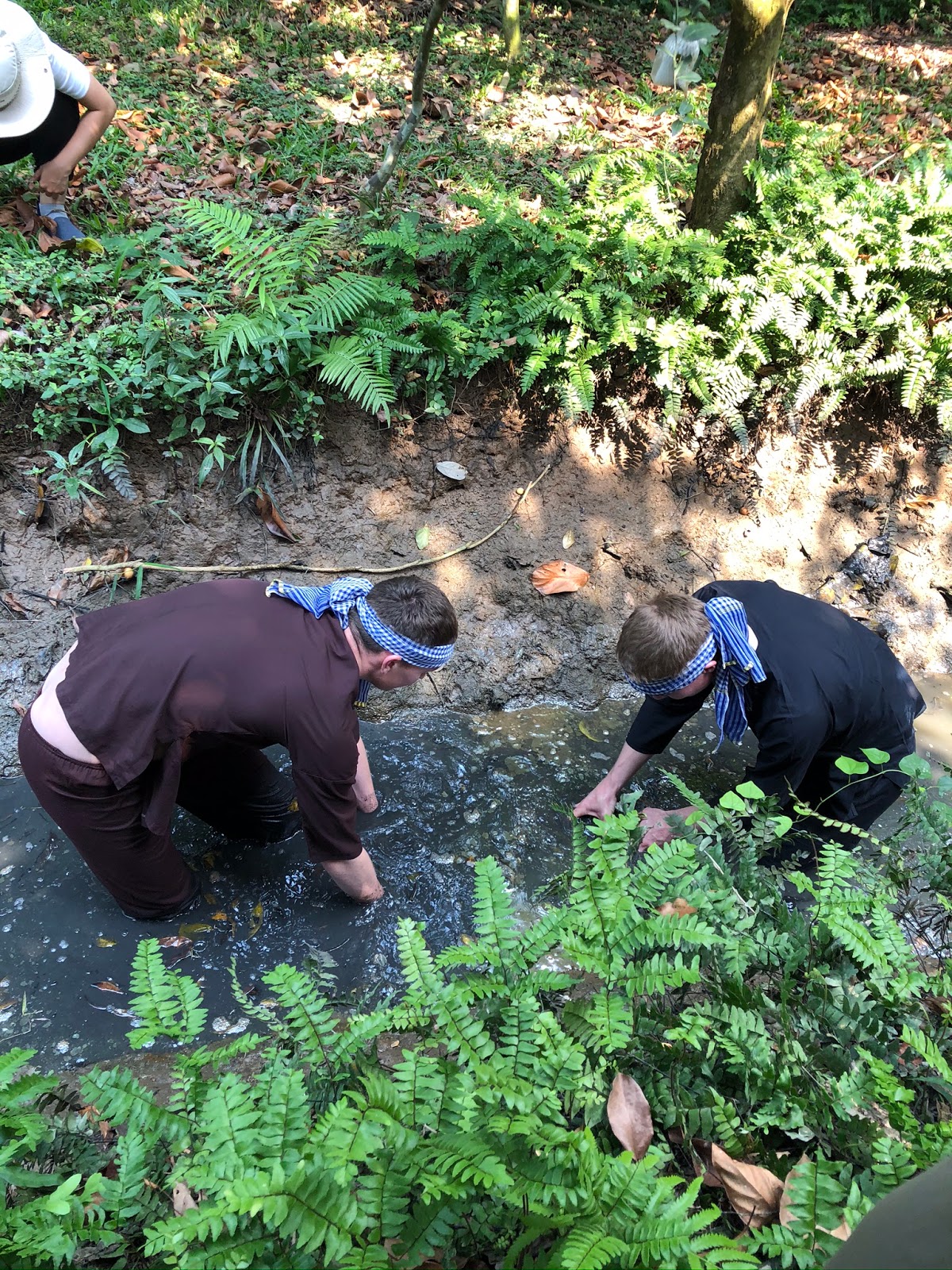
 Grant and Garret work together.
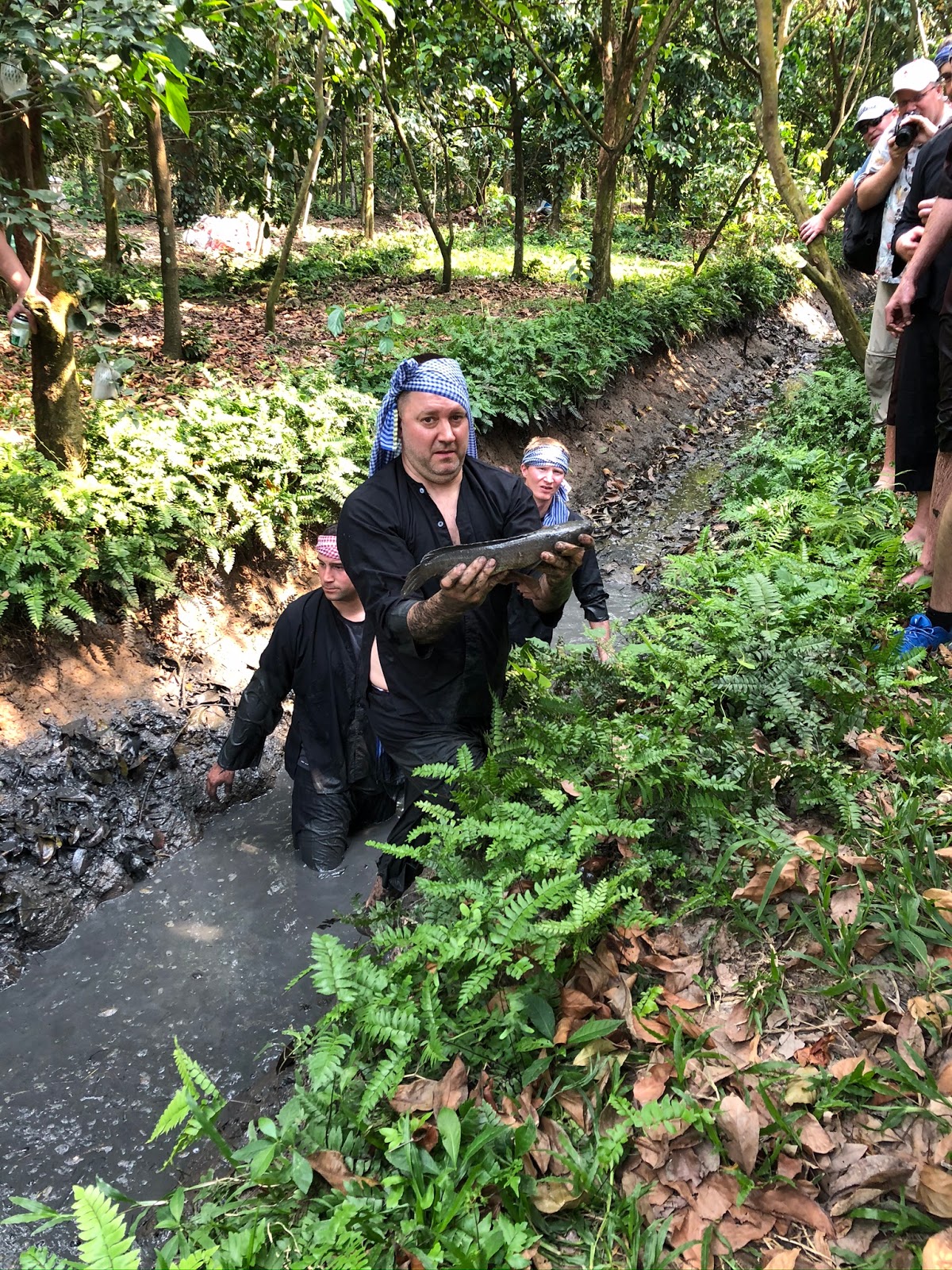
 Chris catches the first fish of the day.

Jake with a fine catch.

The fisherman and fisherwomen were all gamers!  On the way to the fishing channels we walked through their orchard and learned about the 40 types of fruit grown there.  The enthusiasm for what they do is evident in hospitality, energy and pride in their product.  

We concluded the day with a delicious meal at Sao Hom Restaurant in Can Tho.  It was another  successful day in the books for Class X in Vietnam.  We learned that agriculture can come to the consumer in many forms and that the leadership to capture the opportunity can help drive its message.

Ryan Vander Berg and Lorrin Naasz reporters, Lee Freisen &. Jay Esser, photographers 

Wednesday, February 19, 2020

DAY 4 of SDARL CLASS X 2020 LEADERSHIP TRIP to VIETNAM and CAMBODIA

Todays Agenda has us on a bus ride making our way from Ho Chi Min City through the Mekong Delta on to Can Tho City.  As we made out way out of the city, the landscape turned more rural and agricultural.
Our first stop was the Nam Luc Rice factory in Cai Bei.  Can Bei is an important agricultural transit point that sits on the Mekong River. Jessica had shared with us how much Vietnam relies on the Mekong Delta and some of the issues that endanger it. The Mekong River is an important transportation link for southern Vietnam because for two reasons.  First it bisects the major agricultural production area of the southern half of Vietnam from the Cambodian border to the South China Sea.  Second water is a cheap and efficient method of transport infrastructure. Nam Luc rice mill sits on the bank of the Mekong River. It accepts rice by both truck and from river barges.
 Rice barge unloading bags of rice at the Nam Luc rice mill.


Barge transport on the Mekong River.

 At the Nam Luc rice factory, we were able to follow the process from when the rice is delivered, run through a mill by a series of shakers and screens to remove the hulls separated from the kernel and finishing with the white rice that we are accustomed to seeing on our grocery shelves.  


 Grant observes workers unloading bags of mill.


Tyler and workers at the rice mill.

After watching workers transfer 50Kg (110 pound) bags from a conveyor and stacking them by hand in warehouse storage, a couple of us from the class decided to give it a try.  Carrying these bags on our head wasn’t as easy as it looked! 
Reporter of the day Don Nickelson stacks rice bags.

 Some laughs were shared between the workers and the class when some of our guys as well as two of the workers stepped onto the scale used for weighing bags to do a quick size comparison.   
From the Factory we took a boat ride on the Mekong River, stopping to see how rice paper, coconut and rice candies as well as get a chance to hold a Boa Constrictor and enjoy some Snake wine.
Loading the boat for the Mekong River tour.

Our tour guide, Jessica explains processes to make rice paper.
Traditional cooking of rice water to make paper
Fire boiling rice water to make paper.

Sam holds his new favorite friend. The Python was a hit.

  From there we continued on the boat up the river making a quick stop at a floating market to get a taste of some local fruit and drink some fresh coconut water before stopping for lunch at Mr. Muoi Huong’s House.  Lunch was a hands on experience of making our own spring rolls and enjoying local cuisine.

Tilapia at lunch used in making our own spring rolls in a rice paper wrap.


Afterwards we got to experience riding on the Vietnamese Sampan boats winding our way through a canal that merges into the Mekong surrounded by heavy vegetation.

 Don, Lorrin and Heather get ready for the Sampan ride


With our day wrapping up we boarded the bus and made our way to NINH KIEU Riverside Hotel 
in Can Tho.

Today, we learned that much of what we encountered such as the Sampan’s, the stop at the coconut factory and tasting their candies, rice wine, snacks and rice paper are part of the tourism trade that provides the people along the Mekong a living. Yesterday, Benjamin at the Consulate shared a slide that the GDP shows Agriculture is declining in this area and transitioning to trades like tourism. It is one way the locals can showcase the uniqueness of this area, bring agricultural goods to the locals and share their story about their culture. 

Don Nickelson, Reporter; Lance Larson and Grant Harms, photographers.


Tuesday, February 18, 2020

DAY 3 OF SDARL 2020 LEADERSHIP TRIP TO VIETNAM AND CAMBODIA
 TRAVELS TODAY
The flow of traffic is overwhelmingly busy but awesome to witness because the majority of the scooters, cars and trucks buzz like bees in a hive but don’t seem to get agitated at others and have little to no road rage that we have witnessed. 
Today’s agenda consisted of two stops.  They were thought provoking, informative and impactful but each had its own  impact. 
 25th Anniversary of the normalization of relations between the US and Vietnam
The morning consisted of a visit to the U.S. Consulate in Ho Chi Minh City.  
Senior Attache’ for Agricultural Affairs Benjamin Petlock, who works for USDA Foreign Agricultural Service, welcomed us to the Consulate. He  introduced Consul General Marie Damour.  Ms. Damour gave us an excellent over view of the current state of Ag trade between the US and Vietnam following its advancement since the normalizing of relations between the US and Vietnam in 1990.  Her perspective of having served under five US Presidents on all continents helped tell the story of current Ag trade and its interconnectedness to politics, social issues and the global view.  Throughout the years, the US goal has remained the same - to enjoy free, fair and reciprocal trade between our countries.  She also talked about the five strengths of Leadership. They are Curiosity, Willingness to listen, having empathy, ability and a willingness to make tough decisions and then taking responsibility for the consequences.   
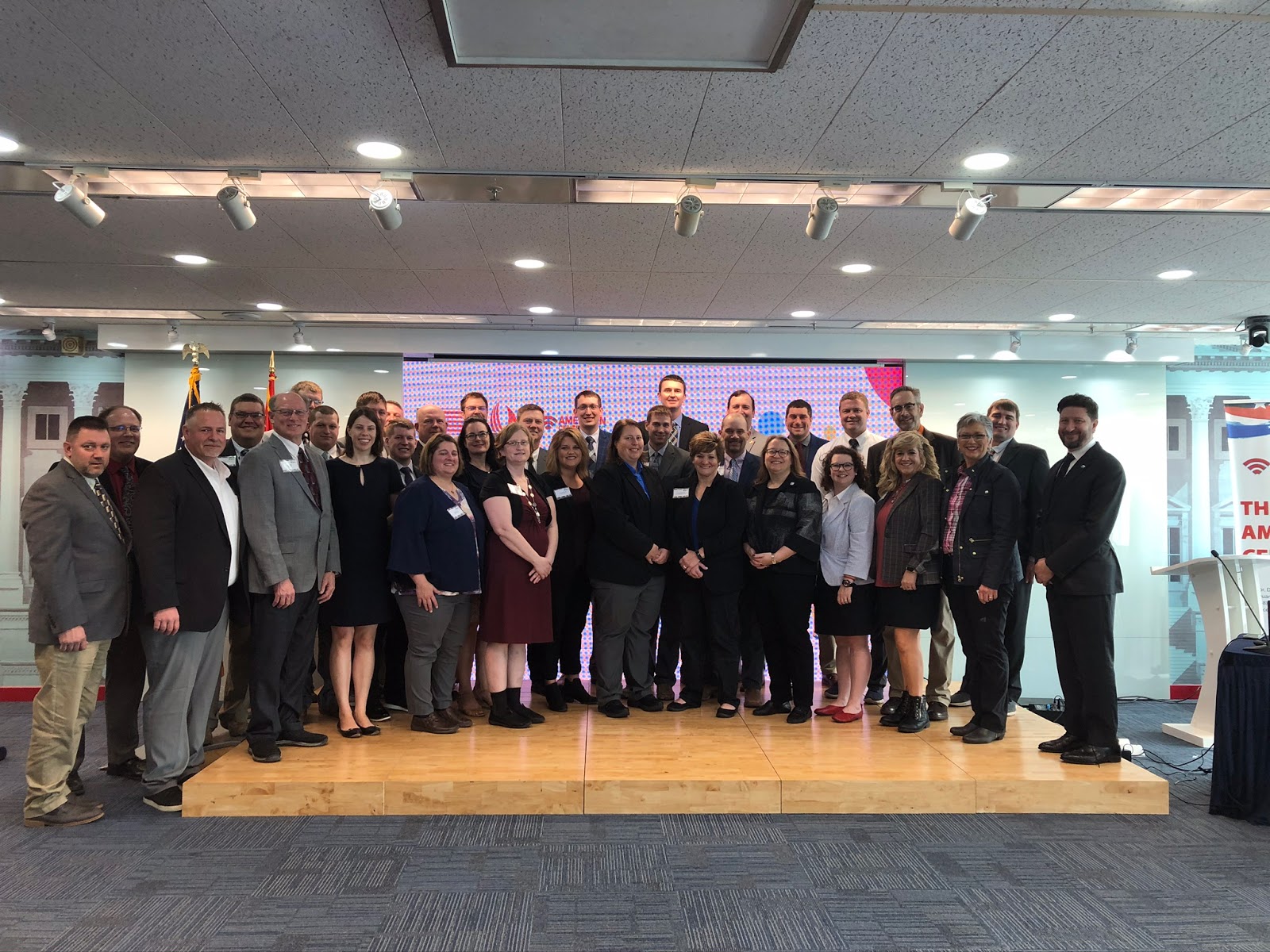
 Class X at the US Consulate
 Consul General Marie Damour
 Class X interacting with Benjamin Petlock and Megan Francic
Mr. Petlock and Megan Francic, the Foreign Ag Service Attache’ for Agricultural Affairs gave their insights on the current Ag trade, its challenges and opportunities in both Vietnam and Cambodia. Vietnam has gone from ranking as the 95th largest export destination for US Ag goods a few years ago to 6th in 2018.  Ben said it is an exciting time to be in Vietnam and Cambodia because with average in Vietnam and Cambodia at under 31, the population curves in both countries pose ample opportunity for growth in the future.  For example in 2018 $3.8 Billion worth of goods was imported by the US from Vietnam of which $157.4 Million was Agricultural:   
Paneled Wood Products = $133.8 Million
Pet Food = $18.8 Million
Rice = $1.2 Million
At the same time, U.S. Exported $445 million worth of goods to Vietnam of which $63 Million was agricultural:
Soybean Meal and DDGS comprised the bulk of the exports at $24 million. Beef and beef products are significantly higher in 2019 as a result of the African Swine Flu.   
Threats to our trade balance include such things as non-science based decisions and following the lead of others based more on emotion than fact.  
A take away from the U.S. Consulate is Vietnam has an impact on Ag in the U.S. and in South Dakota.  Another important take away from this visit for myself was the direct impact the people in the position listed above have on the Ag economy in South Dakota and the U.S. as a whole.  
They were extremely helpful answering our questions and helping us understand the current trade atmosphere.  We were all honored for them to take time out of their day to talk with us. 
Mai Am Thein Than Orphanage


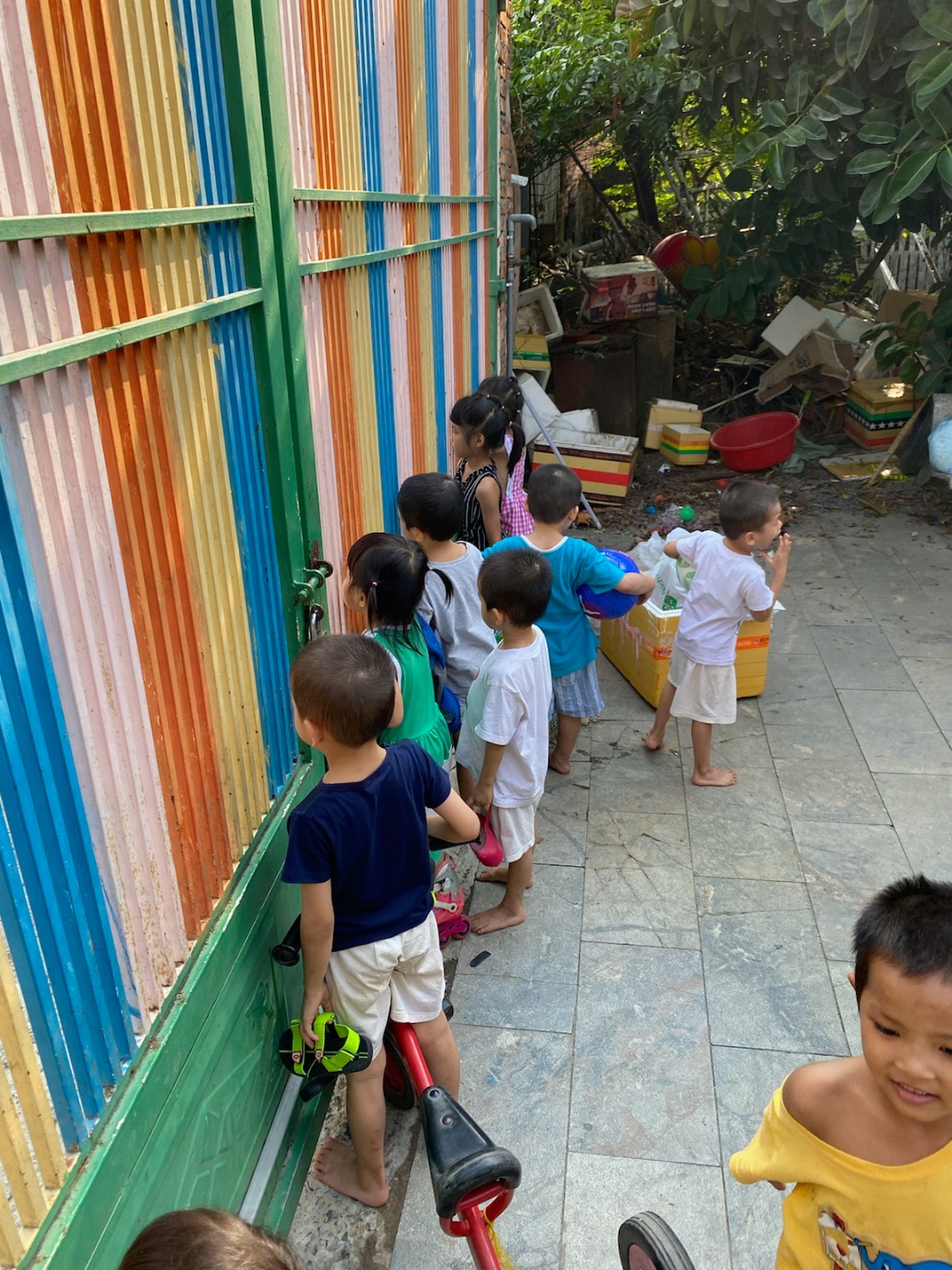
Next on our agenda was visiting this orphanage 1 hour drive from the city center of Ho Chi Minh City.  This orphanage started out because of a local business man who wanted to give these children a place to grow up and be safe.  He has future plans of expansion and the close to 100 children that live there have a safe place to grow up because of his Generosity.   Here we provided gifts to the orphans in the form of books, footballs, soccer balls, crayons and markers with coloring books.  In case anyone is wondering if coloring books and markers are a good idea with 20+ children in a room, I would have to say the kids approved but the staff may have had a different option.  These children ranged from newborns to age 10. We had the opportunity to spend a little over an hour with the children that live there.  Reading, coloring, and playing ball with them.  The impact we had on these children may be minuscule, but the smiles on their faces were immediate. I do know the impact the children had on each member of Class X will be remembered for life.

 Chris Kassube

 Sam Olson and Bob Metz
 Jay Esser
 Lorrin Naasz
The important thing Lori reminded us of is that love and compassion are universal. And wherever we live, it is a reminder that our willingness to engage and become involved for the betterment of our own communities is leadership in action.  
         Tomorrow we head to  Cai Bei and then to Cam Tho.

          Reporter: Lance Larsen; photographers: Grant Harms and Don Nickelson.


Monday, February 17, 2020

DAY 2 OF SDARL 2020 TO VIETNAM AND CAMBODIA
-Ho Chi Minh City
-Words of the day = Sin Chao is Hello and Cam an is Thank You
-After pounding through jet lag, many in the group found themselves waking up between 1-2 am and after the brief shock of waking up in the middle of the night, many easily went back to sleep.
-For those that woke up around 5:30 am for a walk/run it is said that one would sweat a gallon. Vietnam has high humidity this time of year.
-For breakfast we were greeted with a 5 star cornucopia of options (Omelets, Pineapple Jam, Fish, Rice, Pot stickers and much much more.)
-The group left the hotel at 8 am sharp for a tour of  Hi-tech Agricultural Management Centre in Vietnam.
Director of Hi-Tech Ag Center with Jessica as interpreter 


-While driving to the Hi-Tech Centre, we found ourselves in a large bus battling thousands of mopeds. On the way there Jessica (our tour guide) shared the following facts:
-South Vietnam is in the dry season 28-35 degrees Celsius (82 to 95 degrees F).
-Vietnam can experience 10 typhoons between Oct-Dec.
-On our way to the countryside, we passed the Vietnam Military Base that used to be an American base.
- Jessica also said that if you want to date a lady in Vietnam you buy them a Vespa (high end moped) or an IPhone.
-Jessica also made a joke that a lady on a scooter in Vietnam traffic is sometimes referred to as a Ninja because they go wherever they want.
-Coronavirus has effected trade of Vietnam Ag products to China so Melons are cheap right now!
-Vietnam is a communist country so there is not much belief in God or Buddha.  Catholics are reported as six million and Buddhism is reported at 2 million but Jesssica says many do not report because they do not like to give the government much info.
-As we drove to the Hi Tech farm we drove by many rubber tree plantations.
-The Ho Chi Minh Hi Tech Agriculture park has 40 investors with many being from Japan.
-Our guide made it possible to communicate with the presenters at the park.
-The agriculture center is a think tank, organic hydroponics, ecotourism, post-harvest handling, betterment of trade, Medicine, Fertilizer and water consumption research centre.
-Mushroom handling-production and research is similar to university extension
-200 plus employees at the park plus investor employees.
-Local growers can learn for free.  Education is similar to our extension.
-Reishi Mushroom is raised and used as a supplement for homeopathic.
-They were asked what their 1-3 year goals were and they said the future of their research is advanced technology machines for agriculture
-Yarsagumba Mushroom from Tibetan Mountains (Grows on the roots of the trees)

We visited an old rubber tree farm that was abandoned and leased by a woman who started an organic fertilizer farm.  The fertilizer is produced from water buffalo dung and earth worms.  The worms do the work in moist tents that cover the soil/dirt.  When the tents are removed, the sun causes the worms to dive deep and the soil/fertilizer is removed.  Worms can also be harvested for animal feed.
The woman that leased the rubber tree farm was the only woman farmer in the area and made the rubber tree farm profitable.

Compost fertilizer from the earthworm farm

How they remove rubber extraction at the plantation

For lunch we ate at a restaurant along a river with an open air atmosphere.  On the menu was spring rolls, rice, chicken, fish, and a banana for dessert.
On the bus ride to Cu Chi tunnels we received some trivia from our tour guide. Cu Chi Tunnels are a relic left over from the Vietnam War. They are a maze of underground passages, chambers, rooms, and booby traps used by the Vietcong against the American forces.
At the Cu Chi tunnnels many found that the guerrilas of the Cu Chi were resourceful and masters of underground living and warfare.  Walking in the tunnels proved challenging for many.  We only had 3-4 feet of height to maneuver through.


Elli Haerter in the Cu Chi Tunnels

On our way back to Ho Chi Minh, we stopped at a local city government run program for people who are handicapped and affected by agent orange.  Those affected have the opportunity to work on art projects sold to locals and tourist.  The art truly was great pieces of work and many pieces would take 1-3 months to complete.


Many class members bought pieces to bring home. The technique included the use of a bamboo background and egg shells that were cracked and placed onto the canvas.

The final drive home to the city gave the class a rush hour experience down the middle of the city.  The honking here is more out of respect/heads up rather than a rude “get out of my way” mindset.  Some of the strangest things we saw on a moped today included; propane tank, 5’ welding tank, dog balancing itself behind the driver on its own, families of 4, and a chicken cage with a rooster and many more.  We learned by observation that mopeds are a major source of transportation but that only enhances creativity in how they are used.

It’s been a day of breakthrough technology, entrepreneurial spirit, brutal realities of war, show casing of abilities despite limitations and everyday ingenuity.

 Grant Harms, Reporter; Lance Larsen and Don Nickelson, photographers


Sunday, February 16, 2020


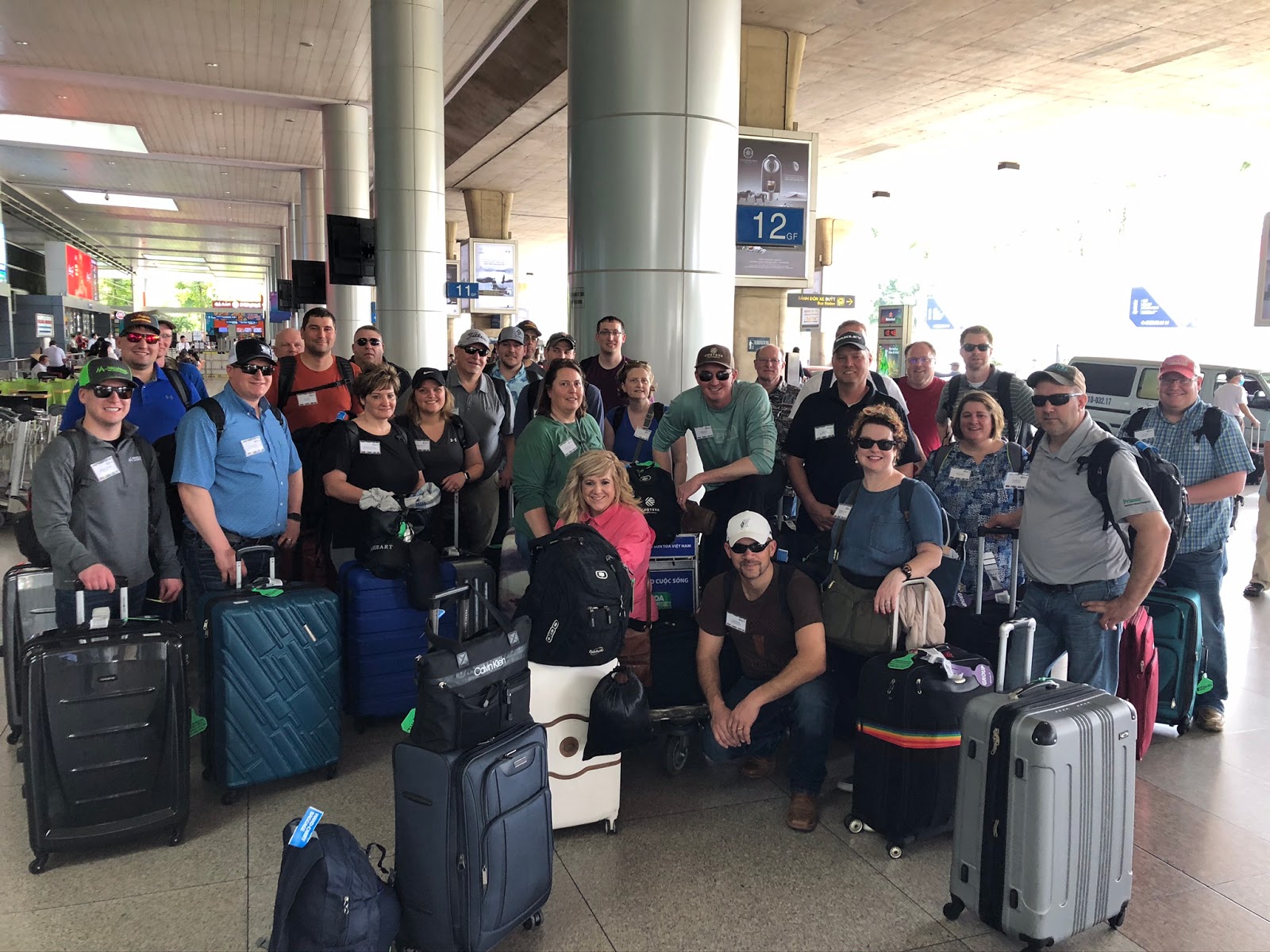
ALL ABOARD EVA AIR IN ANTICIPATION OF WHAT IS ABOUT TO KICK OFF OUR CLASS X INTERNATIONAL EXPERIENCE. Shortly we will board and be on our way knowing that the next 15 hours will be air miles until we reach our Vietnamese stay in Ho Chi Minh City.


Day 1:  Time flies when you are having fun. Starting with the Friday take off in Sioux Falls to Chicago's departure with EVA Air’s “Hello Kitty” for a Sunday stop over to change planes in Taipei before landing in Ho Chi Minh City found us all safe, “warm” and ready to adjust to the 13 or 14 hour time difference depending on which side of the river we call home.


First stop was a six course lunch at a local restaurant.  If presentation is half of the art, this place was a success.  Introduced to some new foods, beverages and conversation centered around a lot of fun expressions and first time experiences coupled with a very warm welcome to Ho Chi Minh City.

 
Spring Rolls 

Dragon Fruit Desert

A major part of SDARL is experience and adapting.  Forks, knives and spoons were set ... but what fun would that be?  Grant shows us the new style.

Wall Drug, Keystone, the old Post Office and Ben Thanh market.  Not sure which came first but the theme is similar.  Heidi found something stylin’ and practical.  Winter in South Dakota to Ho Chi Minh City proved to be a “warm” welcome.  The reported 32 degrees doesn’t sound hot until you do the Celsius to Fahrenheit conversion and find out the cool sounding 32 is 90 F.


To beat the heat, Heidi joined the locals in a look that is quite popular here and makes sense when we know that we will be spending parts of our day in the full on sunshine and heat here in Vietnam.


Thursday, February 13, 2020

Vietnam on the Horizon

SDARL CLASS X HAVE THEIR BAGS PACKED AND ARE READY TO EXPLORE VIETNAM AND CAMBODIA FEB 14-29, 2020

On Feb 16, we will arrive Ho Chi Minh City (formerly Saigon) located in the Southeastern part of Vietnam. Each day SDARL members will be blogging and sharing their daily experiences. We look forward to sharing more about the culture, customs, agriculture and rural life. We look forward to the nature, beautiful landscape, rivers, history, and adventures that is part of our travel itinerary. Come back often and enjoy their experiences. We will be back with updates once we get settled in.