Monday, February 19, 2018

Day 9: Punjab University and Flower seed farming

Blog post written by Lacey Caffee and Jason Warrington

Dr. KS Think, Director of Research at PAU
This morning we started at the number one agriculture university in India, Punjab Agricultural University, PAU, in Ludhiana. Due to connections with PAU scientists via colleagues at SDSU, Jon Kleinjan was picked up early, met with the Director of Research, and was given a private tour of the wheat breeding plots.  Jon was impressed with the types of research being conducted, noting that the PAU wheat breeding program was doing extensive work with both hybrid wheat and genomic trait selection.


About an hour later, the rest of the class arrived at campus.  We met with Dr. KS Thind, the Additional Director of Research (Crop Improvement), and senior members of his faculty.  He began his presentation by explaining that PAU is one of the most agriculturally advanced universities in India.  Included in his discussion were important facts about PAU, including founding and evolution, undergraduate programs, research and extension, crop variety releases, achievements in crop improvement, and Indian agricultural concerns.  Dr. Thind also discussed the agricultural importance Punjab, which is the leading agricultural state in India.  Punjab produces 38%, 37%, and 28.5% of India’s wheat, honey, and rice, respectively.


The key takeaways included the advanced status of PAU in mechanization, soil health issues, and plant breeding.  Surprisingly, PAU researchers are in favor of genetically modified organisms (GMOs) and hope through the education process to alter any negative sentiment from the general public.  They are promoting more machinery usage and implementing better cultural practices, including no-till for wheat following rice.  And, alternative uses for wheat and rice straw that don’t include burning the fields and creating air pollution.


After our discussion, we were taken on a short tour by Dr. Grueupkar Singh, Assistant Professor of the Agriculture Biotech Research facility.  Researching disease resistance in plants, they use jars to grow clones of different kinds of plants in order to develop and test new varieties which can be released to farmers for production.  We saw them in several different growth stages.  Dr. Yogesh Vikal, Sr. Geneticist, showed us around the room where they do the gene mapping. 
Genetic clones growing in the lab
Showing us some of the projects being worked on

Rob Thuringer inspecting one of the samples.
Concluding our tour of PAU was a tour of the Food Industry Business Incubation center, basically a commercial kitchen to allow producers to value-added production.  They have the facilities available for farmers to process their fruits and vegetables into any number of products for retail sale, not just informal market sales.  They have washing, canning, and processing available for a nominal fee.  We tried sugarcane juice, which is so well preserved they don’t have to keep it cold.   They estimate most products made there can generate a 40% profit for the farmers.
Some broccoli being prepared for packaging.
Adam Ehlers inspects the large cooking pots at the food center
Our group with hosts at PAU

Displaying some of the products made in the value-added center
After lunch busing to the flower farm, we drove by a place along the road where bricks were being made.  The farmer’s lease out the land and workers make bricks out of it.  They dig to a certain depth level per what the farmer asks.  When they get done, it’s all leveled out for the farmer to plant wheat and other crops. 
Brick layers working in fields along our drive

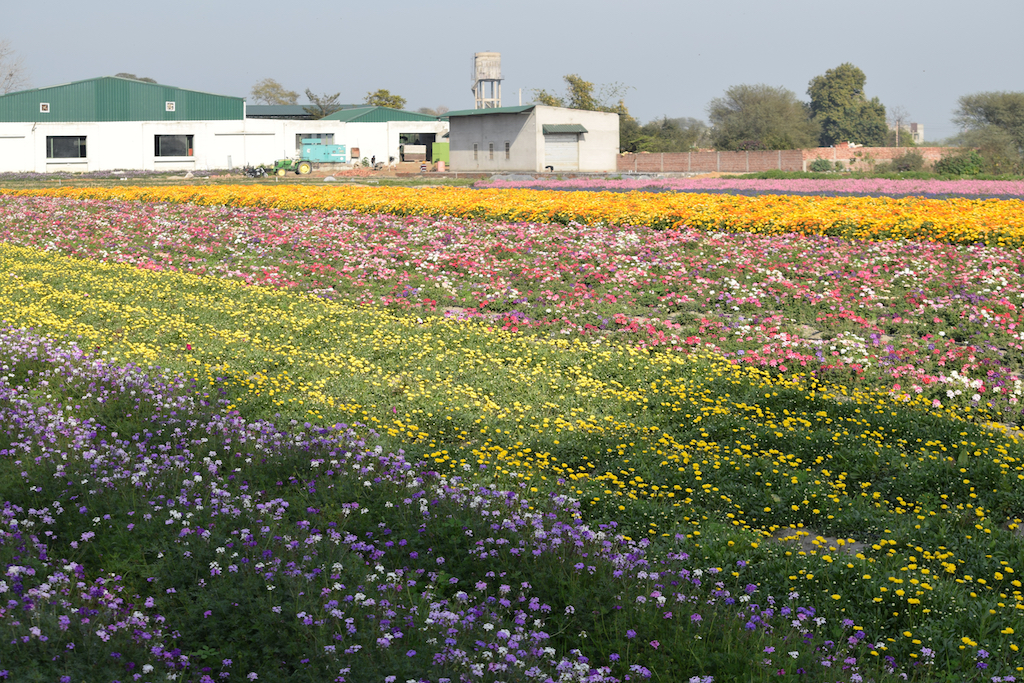
Beauscape Farms was just beautiful! Avtar Singh Dhindsa and is wife were fabulous hosts.  Beauscape began the flower farm in 1985 and has excelled into India’s largest flower seed supplier.  He supplies 50% of the country’s seed.  On the worldwide stage, he has wholesalers in over 100 countries.  This includes Japan, Australia, Europe, and the United States.  Applewood Seed Company in Colorado is one of his major buyers in the U.S.


 Beauscape Farms was just beautiful! Avtar Singh Dhindsa and is wife were fabulous hosts.  Beauscape began the flower farm in 1985 and has excelled into India’s largest flower seed supplier.  He supplies 50% of the country’s seed.  On the worldwide stage, he has wholesalers in over 100 countries.  This includes Japan, Australia, Europe, and the United States.  Applewood Seed Company in Colorado is one of his major buyers in the U.S.


He had a question/answer session and a tour.  Beauscape focuses on seed production in the wholesale division.  They sell in bulk to other companies; then package the seeds and distribute them for retail. His farm is comprised of 800 of acres in Punjab and another 500 in southern India. This leads them to export 30-40 tons of 650 different varieties of flower/vegetables seeds a year.

Inspecting the seed sorting equipment
Inspecting the flood irrigation channels.  Punjab State has invested
in several large canals that helps keep irrigation water flowing.


After seeing several of the flowers in bloom, we discussed harvesting the flower seeds.  The harvesting is all done by hand; therefore, it is the most expensive part of the whole process.  Manually sorting seeds isn’t the most cost efficient.  Ideally machines are used for sorting seeds.  They had to create several of their own machines, including one that takes the fuzz off some of the seeds heading to Japan.  As we were guided around the processing area, we saw cleaners, sorters, and bagger machines.  The seeds need to be 99.9% dry and no swelling, so cloth bags are used instead of plastic. 
These ladies were sorting squash seeds for planting in the coming days.
Most of their labor is hand work done by local villagers


Sunday, February 18, 2018

Day 8: Traveling to new regions of India

Today, Sunday, was a big travel day for Class 9 on their international experience in India.  We said goodbye to Agra and boarded the bus for a 4-hour drive to Delhi.  The drive gave us an opportunity for a class meeting and debrief of the last few days.  We did a class exercise to role-play being a South Dakota tour guide for our India tour guide, Raj, highlighting what our state of South Dakota has to offer in terms of Ag Production. We discussed livestock production including cattle, sheep, buffalo, turkey and swine. Also, grain production of wheat, soybeans and corn along with ethanol production. We of course had to highlight Sturgis Motorcycle Rally, Black Hills Stock Show, Local Rodeos, 4th of July Celebrations and Annual Pheasant Hunting. 

We drove past a number of these stacks which are brick kilns.
The constant building of new structures in India requires a lot of
red brick for all the walls and they come from small business owners
 who mix, form and fire the bricks.
As far as Class 9’s overall consensus of India to date: each of us has truly enjoyed this full immersion experience to the India culture not only of Taj Mahal but every day we have had to date.

On the bus, we took a different route than previous and travelled via the new, four-lane freeway which allowed us to make good time and the traffic was not as hectic.  The freeway crossed directly through relatively undeveloped areas, which gave us the opportunity to view the countryside of India while in transit.

When we arrived in New Delhi, where we’ll be flying from on Thursday, we stored our main luggage at the hotel and utilized only our backpacks for the next three days.   Once completed at hotel, we ate lunch at a hotel called Chore Bizzare in Old Delhi complete with old world charm.  The food they served was Kashmiri and Mughlai.  After lunch we made our way to a huge train depot in Delhi. 

Waiting on the platform 
Simple but clean and comfortable train car for the 4 hour ride to Ludhiana
We boarded a train and travelled another 4 hours northwest to the town of Ludhiana.  This was quite an experience for almost everyone in the class as very few had ever ridden on a passenger train prior to this trip.  Trains are a common and well-developed mode of transportation in India, so it was fun to ride on the rails a bit. The train only stops for 3 minutes at our destination so we had to make a quick exit and were glad that we didn’t have our big suitcases to deal with. The train was very comfortable for everyone and a nice change to the cramped modes of travel we have experienced on the buses and planes.


Tomorrow we'll explore Ludhiana with time at the Punjab Agriculture University and a tour of a flower seed production farm.  Stay tuned!


Written by Kyle Schell and Brian Bannwarth

Saturday, February 17, 2018

Visiting the Taj Mahal

Written by Kyle Schell and Brian Bannwarth

Class 9 started the day visiting Taj Mahal one of the 7 Wonders of the World. It is an ivory white mausoleum setting on  42 acres to house the tomb of Mughal Emperor Shah Jahan’s favorite wife in1631 and was completed in 1653.  She died in 1631 after giving birth to her 14th child. The grounds also have a mosque and guest quarters and garden.  The Emperor’s two other wives are also laid to rest nearby. 


The Taj Mahal is an actual moat support by 96 pillars by use of water hydraulics.  The large center dome is counter balanced by the four 130 feet tall towers in the four corners of the monument.   Mughal Emperor Shah was precise in terms of symmetry when building the Taj Mahal. The only thing asymmetrical was himself as he was laid to rest following his death in 1666 facing west towards Mecca versus facing his wife as required by Islamic law. The grounds are surrounded by a large garden with raised pathways with a large reflecting pool called the Tank of Abundance.

Our guide, Raj, gave us a thorough history and information about the Taj Mahal and the gardens.


After Taj Mahal, we visited Akbar International Marble. Mr Shahid explained the marble inlay process. They would scratch the marble 2.5mm in depth and then inlay the precious and semi-precious stones and seal with a special glue. Akbar International is a leading supplier of marble paintings, marble inlay, and products. They specialize in superior makrana marble as found in the Taj Mahal.  It is a crystalizied marble making it nonporous and  higher quality than what we see in the United States.
Craftsmen take small slivers of semi-precious stones, then polish, shape, and work the stones
against a grinding stone with their left hand while controlling the speed of the wheel with the other. 

The finished product of inlaid marble.
Then off to visit Saint Mother Theresa Orphanage.  This orphanage serves the children of special needs as they were abandoned at birth due to deformities both physical and mental.  We toured the grounds, living quarters and soup kitchen. It is operated by 9 nuns and serve children from birth onward.  It was very basic facility and they work with what they have. We donated clothes, toiletries and money for the children.


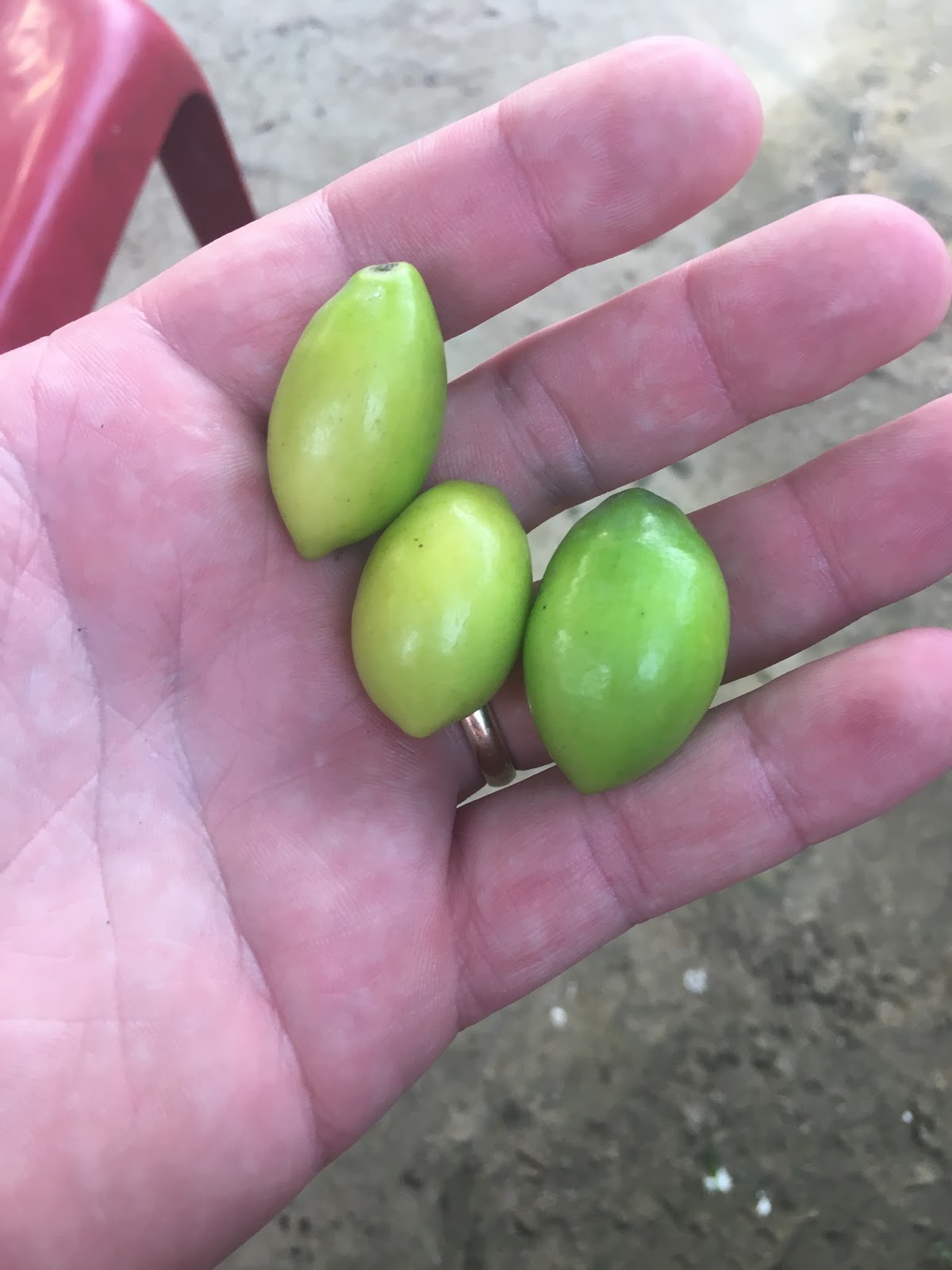
We finished the day visiting a local production farm.  The farm consisted of 20 acres and produced wheat, mustard, and variety of trees including lime, banana, guava, mango, hard apple, starfruit, and berries.  The berries were larger than what we think of and tasted similar to apples.  The farmers that worked the farm were very gracious making tea over an open fire for the very first Americans they had ever come in contact with.  One of the gentlemen had never even heard of the United States but enjoyed seeing pictures of some of our agriculture practices on our cell phones.  There was a 400-year old religious Hindu temple dedicated to Lord Shiva on the farm that we drank our tea by.  We also got to see beehives in their natural habitat hanging from tree limbs.  There was no modernized machinery on this farm and everything was planted and harvested by hand.  After seeing this farm, its clear to see they have a different element to diversified farming.


Touring the orchards

Every day they cut fresh grasses and then chop it using this device,
then mix it with straw to make cattle feed.

These are "berries" eaten by the locals and grown at the farm.
They're actually more like a plum with a large seed in the middle.
Delicious!

Our hosts with the women of the SDARL class


At dinner, the curry proved to be a bit hot for this South Dakotan.
The ladies had to fan Kyle!